Hi, I’m Laura, and I’m so happy you’re here.
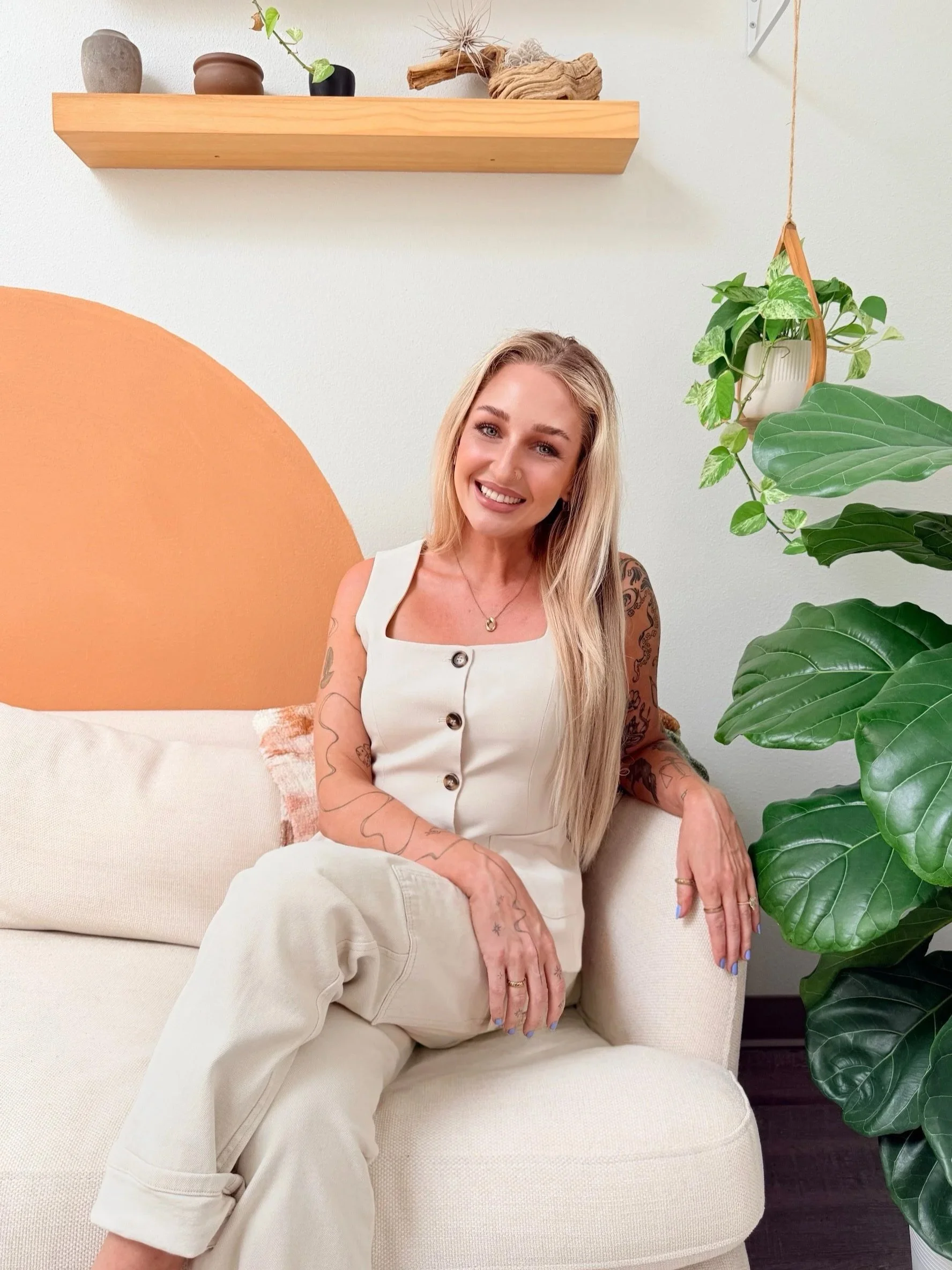
I believe healing and growth happen within relationships - through being seen, understood, challenged, and supported.
Whether you're reaching out for therapy, clinical supervision, or consultation: my hope is that you find a space where you can bring your full humanity without needing to perform, minimize, or have everything figured out.
Over the years, I've had the privilege of working with individuals from a variety of backgrounds and across multiple levels of care. My experiences, both personally and professionally, have shaped an open-minded, adaptive perspective that supports people in growing, healing, deepening their understanding of themselves, and creating lives that feel more authentic and aligned.
I practice from an integrative, relational lens: meaning there isn't a single modality or manual that guides my work, and I place significant emphasis on the safety, trust & connection of our human-to-human relationship. I draw from a range of evidence-informed theories and cross-cultural understandings of ‘healing’ to meet each individual, couple, or family where they are when they reach out for my support.
Rather than attempting (& failing) to comprehensively list each influential theory, modality, framework, person or group - I've highlighted just a few that continue to shape & inform my approach:
Gabor Maté’s compassionate inquiry, attachment vs. authenticity, and honoring the adaptive ways we learn to survive.
Trauma-informed and parts work approaches, heavily influenced by Dr. Judith Herman, Linda Gantt, & Richard Schwartz: understanding ‘symptoms’ as meaningful adaptations while fostering curiosity, integration, and self-compassion.
Dan Siegel’s interpersonal neurobiology & fundamental interconnectedness: recognizing that our minds, brains, bodies, and relationships continually shape one another - individually & collectively.
Liberation-oriented, psychodynamic, and systems theories: understanding people within the context of their relationships, environments, histories, and communities.
Intersectional, cross-cultural practices: acknowledging many historical, indigenous, & ‘alternative’ healing practices that have only more recently been recognized or supported by contemporary psychology, neuroscience, and/or western medicine. Honoring & reintegrating principles that have long existed across cultures and communities - particularly in the enduring role of connection, belonging, and relationship in healing.
Ultimately, my goal is to cultivate spaces where people are not asked to become someone entirely different, but are supported in coming home to themselves: where clients and clinicians alike feel empowered to challenge their wounded, oppressive narratives, embrace authenticity, and engage with themselves and others in ways that are more compassionate, meaningful, and whole.
I most often find myself working with individuals, couples, and families navigating:
Singular, chronic and/or complex traumas, PTSD, & stressors that make daily life feel increasingly difficult to sustain
Major life transitions (retirement or separation from active duty service, marriage, divorce, career shifts, grief/loss/death, major moves, etc.)
Family dysfunction, estrangement, or conflict; attachment wounds
Recognizing themselves within obsessive-compulsive loops but don’t feel accurately represented by normative depictions of ‘OCD’
Trying to reconcile external ‘achievements’/’high functioning’ with internal feelings of inadequacy, hopelessness, or deficiency
Identity confusion or exploration, chronic shame and self-worth struggles
Relational and/or sexual dissatisfaction, dysfunction, conflict or those having trouble finding or maintaining relationships that feel mutually fulfilling
Feeling ‘stuck’ or stagnant despite years of therapy/‘self improvement;’ feeling as though your thoughts, feelings, behavioral changes, or lifestyle don’t match your efforts
Wherever you find yourself right now, I'd be honored to meet you there.
My Approach
Humanity over Pathology
I show up as a real person. Therapy shouldn’t have to feel sterile or performative. I approach the people in front of me through a lens that honors the impact of trauma, relationships, identity, culture, as well as systemic and generational factors. Together, we make room for complexity and challenge narratives that leave people feeling broken or disconnected from themselves. I believe genuine connection, humor, honesty, and mutual humanity are essential ingredients for meaningful growth.
I believe healing and growth are not about fixing what is broken, but about making meaning, reclaiming humanity, and creating room for more liberated and connected ways of being.
Collaborative & Curious
You are the expert on you. Our work’s foundation is your story - built upon together using empowerment, flexibility, and collaboration. I bring clinical knowledge and perspective; you bring your lived experience. Together, we create something tailored to who you are - not who you think you're supposed to be.
I believe curiosity creates possibilities where shame often creates paralysis. I approach people with warmth, humility, and the understanding that behaviors make sense when we understand the context surrounding them.
Integrative & Intersectional
I tailor my approach to the person in front of me rather than relying on one-size-fits-all, formulaic solutions. Together, we'll explore not only symptoms, but the relationships, histories, identities, and experiences that shape how you move through the world. I intentionally incorporate intersectional, neurobiological, and sociological perspectives while amplifying wisdom that exists beyond dominant Western models of healing. I aim to cultivate a safe space rooted in trust & connection in order to facilitate a corrective reprocess of past experiences contributing to present-day pain.
Credentialing, Education & Licensure
Licensed Professional Clinical Counselor #15038
NBCC & CACREP accredited, registered with the Board of Behavioral Sciences.
Master of Arts, Clinical Mental Health Counseling, Concentration in Trauma & Human Sexuality; University of San Diego SOLES
Research Associate - Dr. Nedeljko Golubovic: Trauma/Addiction Laboratory
Research Associate - Dr. Ana Estrada: Positive Psychology Laboratory
Bachelor of Science, Psychology & Child Development; Texas Christian University
Research Associate - Dr. Kenneth Leising:Memory-Cognition Neuropsychology Laboratory
Research Associate - Dr. Sarah Hill:Health & RelationshipLaboratory
Professional Development & Training Highlights
My work is continually shaped by ongoing learning, consultation, lived experience, and professional development. The trainings below represent a selection of experiences that have significantly informed my practice.
The Healing Power of Relationships: 4-Day Summit (Relational Life Institute)
Attachment Theory in Practice (CAR; PESI)
Clinical Treatment of Domestic Violence (IVAT)
Veteran Competency (Veteran Affairs)
OCD Subtypes: Identification & Treatment (NOCD)
Beyond Media Stereotypes & Exposure Therapy: A Neurodiversity-Affirming Approach to Understanding & Treating Obsessive Compulsive Disorder in LGBTQ+ and Marginalized Populations
Instinctual Trauma Response: 101, 102, 103 (ITR Training Institute)
Internal Family Systems & IFS for Complex Trauma (IFS Institute)
Racial Injustice & Trauma: 1 & 2 (PESI; S. Kent Butler, PhD, Gail Parker, PhD, and Monnica T. Williams, PhD, Deran Young, LCSW, Amber Flynn, LCPC, and Lambers Fisher, LMFT)
Energetics of Rage, Shame & Grief (Dr. Jennifer Mullan, PsyD)
Features & Contributions
2025
2026
2025
2019
Phone: 619-324-9177
Email: laura@journeyconfluence.com
Address: 1111 Fort Stockton Drive, Suite #H
San Diego, California 92103
I currently offer secure, virtual teletherapy for clients throughout California. Beginning November 2026, I look forward to welcoming in-person clients in Mission Hills, San Diego at the HellaGood Therapy Co-Working Office.
As I prepare for several pre-planned travel commitments this fall, I have intentionally chosen not to begin offering in-person appointments until I am able to do so consistently. Rather than starting in-person care only to interrupt it, I'd rather ensure that the way we begin our work together reflects the reliability and presence I strive to offer throughout our work.